OBJECTIVE: The objective of this
study was to compare the dislocation of the center of gravity and postural
balance in sedentary and recreational soccer players with and withoutanterior
cruciate ligament (ACL) reconstruction using the Biodex Balance System (BBS). METHOD: Sixty-four subjects were divided into three groups: a) soccer
players who were post- anterior cruciate ligament reconstruction; b) soccer
players with no anterior cruciate ligament injuries; and c) sedentary subjects.
The subjects were submitted to functional stability tests using the Biodex
Balance System. The instability protocols used were level eight (more stable)
and level two (less stable). Three stability indexes were calculated: the anteroposterior
stability index, the mediolateral stability index, and the generalstability index for all
the subjects of the experiment. RESULTS: Postural balance (dislocation) on the reconstructed side of the
athletes was worse than on the side that had not undergone reconstruction. The
postural balance of the sedentary group was dislocated less on both sides than
the reconstructed knees of the athletes without anterior cruciate ligament
injuries. There were no differences in postural balance with relation to
left/right dominance for the uninjured athletes and the sedentary individuals. CONCLUSION: The dislocation of the center of gravity and change in
postural balance in sedentary individuals and on the operated limb of Surgery
Group are less marked than in the soccer players from the Non Surgery Group and
on the non-operated limbs.
The dislocation of the center of gravity and the change in postural balance
from the operated limb of the soccer players is less marked than in their
non-operated limbs.
Proprioception –
taking a balanced approach to sport
When it comes to
sport performance, power, strength and endurance can only take you so far.
Whether you’re a footballer dribbling the ball, a gymnast on the bars, or a
rugby player diving for the line while fending off tackles, balance is
absolutely critical for performance. John Shepherd takes a look at how balance
and proprioceptive training and the mechanisms that lie behind this skill
can be improved.
Balance in sport
involves a complex interplay between numerous factors. A number of these are
conscious – such as deciding to move a limb to prevent yourself falling at the
same time as performing a skill eg a basketball shot – while many more are
unconscious. The unconscious element involves the ‘use’ of in-built sensory
mechanisms and programmed responses. This is known as ‘proprioception’.
Proprioception has been called the ‘sixth sense’ and is basically a mechanism
(or, more accurately, a series of mechanisms) that keeps track and controlof muscle tensions and movement in the body.
When you consciously
make movements or are subjected to external forces, your muscles, ligaments and
joints will be making their own ‘judgments’, based on the information that they
receive from their own sources. These judgments are then used to invoke
mechanisms to control movement (more about this later). These mechanisms are
known as sensorimotor processes, and scientists have been investigating how the
senses consciously and subconsciously react with one another to control
movement (known as sensorimotor research). Sports scientists now believe that
sensorimotor ability and proprioception can be enhanced by specific practices.
Mechanics of
proprioception
Proprioception is
achieved through muscles, ligaments and joint actions using messages that are
continuously sent through the central nervous system (CNS). The CNS then relays
information to the rest of the body literally ‘telling’ it how to react and
with what amount of tension/action. Some of these instructions go to the brain,
where more often than not they are acted on unconsciously, whilst others go to
the spinal cord, where they are acted on automatically.
Proprioceptors are
basically ‘sensors’ that reside within muscles, joints and ligaments. These
respond to pressure, stretch and tension and are key in initiating what is
known as the ‘stretch/reflex’. You will probably be familiar with the
stretch/reflex as a mechanism in the everyday sporting context when trying to
stretch a muscle beyond its sticking point – a point will be reached when the
muscle will not want to stretch any further. This is the result of the
stretch/reflex mechanism kicking in and trying to prevent the muscle from being
stretched further.
Although not so readily
apparent, the stretch/reflex also provides control over other functions eg your
postural muscles, which maintain the balance of the body against gravity. This
makes it a global as well as specific site muscle mechanism. An example of this
is if you were holding a weight in your outstretched hand and then had more
added; the stretch/reflex would attempt to make the adjustments necessary to
allow you to continue to hold the added load by ‘tweaking’ all the supporting
muscles and influencing your posture.
Injury can
impair proprioception
Injury can reduce
the effectiveness of an athlete’s proprioception, something that the athlete
and coach may not be fully aware of even when rehabilitation seems complete. A
team from the University
of Pittsburgh looked at
the role of the sensorimotor system as it relates to functional stability,
joint injury and muscle fatigue of the shoulder and the restoration of
functional stability after shoulder injury (1). They noted that to fully
restore shoulder stability, deficits in mechanical stability, proprioception
and neuromuscular control are needed.
Specificity
and proprioception
The rule of training
specificity states that the greatest sports improvement gains will be derived
from the most sport specific exercises for that sport. Thus for example, a
sprint athlete will get greater returns from plyometric training, in comparison
with weight training. However, it is possible that even these specific training
means may not fully develop proprioceptive ability.
Mark Alexander,
writing for PP’s sister publication Sports Injury Bulletin, notes that a focus
on speed and power exercises, with their emphasis on fast-twitch muscle fibre may in fact disrupt proprioceptive ability (3). He
indicates that fast-twitch muscle fibre is less adept at monitoring and
controlling muscle tension when compared with slow-twitch fibre because of the
quicker speed of neural impulses being sent and interpreted through muscle
spindles and spinal motor neurons.
Thus it is argued
that balance type exercises need to be performed at slower paces to optimally
enhance proprioception. These allow postural stabiliser muscles, with their
greater predominance of slow-twitch muscle fibre, to supply enhanced movement
control. An example of a stabilising muscle is the soleus muscle of the lower
leg, while the other major calf muscle (the gastrocnemius) is the ‘fast-twitch
fibre rich prime mover’.
Balance type drills
are seen to improve not only proprioception, reducing potential injury, but
also the ability of an athlete to express power. To explain this, think of a
high jumper planting off their curved approach to leap dynamically skyward. The
forces going through the athlete’s prime mover leg muscles need to be
controlled by the stabilising muscles. The more effective these muscles are,
the more effective the power output will be from the prime movers. This is akin
to the fine-tuning of a race car’s suspension (which can be equated to the
stabilising muscles), where small tweaks can greatly enhance the geometry of the
car and therefore the speed produced by its prime mover – the engine.
To counter the
thoughts of those who might still advocate faster movements for the development
of proprioception, it is necessary to differentiate between proprioception and
kinaesthetic awareness. Kinaesthetic awareness is about the ability of an
athlete to perform a dynamic sporting skill, perhaps from an unstable position,
and involves the conscious control of the body in space and time in order to
affect a sports skill. This differs from the more automatic nature of
proprioception responses.
Proprioceptors are specialized sensory receptors
on nerve endings found in muscles tendons joints and the inner ear.
What is Proprioception?
Proprioception is the sense
of knowing where your body part is in space.
This can be a difficult concept to grasp until you lose it, because so much
proprioception occurs subconsciously.
Your proprioception capabilities can be impaired when joints
are injured, such as with ligament sprains. When you lose proprioception
of your joint after a sprain, you may experience an unstable
sensation of the joint. Your joint may even give-out.
The most common symptom of reduced proprioception is poor balance.
In this respect, most people can understand the concept that poor balance can
be a result of poor proprioception. However, even your spinal posture has a
proprioception component telling you whether or not you are sitting or standing
upright. Good posture, for example, could be thought of as perfect
spinal balance!
Every injury has the potential to decrease your proprioception
and subsequently your balance. However, you can quickly improve both your
proprioception and balance with proprioception and balance exercises. That's
where your coach has to be an expert and can help you if does the job properly.
What are Proprioception / Balance Exercises?
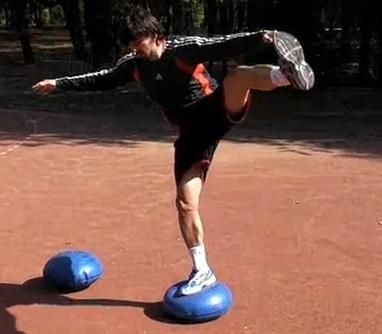
Proprioceptive and balance exercises teach your body to control the
position of a deficient or an injured joint. An common example of a
proprioceptive or balance exercise is the use of a balance or wobble
board after an ankle sprain.
The unpredictable movements of the balance board re-educates your body to
quickly react to the wobbly movements without having to think about these
movements.
That is, your natural balance and proprioceptive reactions that we are
attempting to retrain make the transition from a conscious to
a subconscious state. A quality subconscious proprioception
and balance system is important in everyday life and particularly in sport.
Elite athletes are not thinking about how to stay balanced as they pass or kick
a ball. That all happens automatically behind the scenes. The best athletes can
then elevate their performance by focusing on what they plan to do with the
ball and performing that match winning skill rather than wasting their mental
power on just staying upright.
How Does Your Proprioception or Balance Improve?
Proprioception exercises are designed to improve your proprioception
feedback circle.
In simple terms, your brain sends electrical contract or relax
messages to your muscles. Your joint movement response
is detected by your sensory nervous system and reported
back to your brain for fine tuning and improvement with repetition of
the process.
In other words, perfect practice will eventually mean proprioception perfection.
There are hundreds of injury specific proprioception and balance exercises
whether your injury is your shoulder, elbow, hip, knee, ankle or spine.
It is possible to commence advanced proprioception or balance exercises too
early, which can be detrimental to your rehabilitation outcome. Once you go to the proprioception training, if
going after injury, start very light exercises. Make sure to do the gradual
increase in your intensity and exercise hardiness, don’t push too hard, listen
to your coach and everything will go in the directed path.
Static stretching is
the most common type of stretching. You gently assume a stretch position and
hold it for 20 to 30 seconds. There is no bouncing or
rapid movement. You should feel a mild pulling sensation, but no pain. You
should feel the stretch in the belly of the muscle, not in the joints.
2. Passive Stretching
Passive stretching
is also known as relaxed stretching and it's basically the same as static
stretching. The only difference is that with passive stretching you don't supply
the force to stretch a muscle, a partner or some type of apparatus does.
3. Dynamic Stretching
Dynamic stretching
consists of controlled leg and arm swings that gently take you to the limits of
your range of motion. There is no bouncing or rapid movement. Examples of
dynamic stretching would be slow, controlled leg swings, arm swings, or torso
twists.
4. Ballistic Stretching
Ballistic stretching
consists of trying to force a part of the body beyond its normal range of
motion by bouncing into a stretched position. An example of ballistic
stretching would be bouncing down repeatedly to touch your toes. Ballistic
stretching can lead to injury and should only be used by highly conditioned athletes who need to prepare for a volatile, high-speed
activity.
5. Active Isolated (AI) Stretching
AI stretching
consists of assuming a position and then holding it there with no assistance
other than using the strength of your muscles. An example of AI stretching
would be bringing your leg up high and holding it in
that extended position. The theory is that as one muscle contracts the opposing
muscle will relax, resulting in a better stretch. AI stretches can be difficult
and rarely need to be held any longer than 10 to 15 seconds.
6. Isometric Stretching
Isometric stretching
consists of getting a muscle into a stretched position and then resisting the
stretch isometrically. An example of isometric stretching would be having a
partner hold your leg up high while you attempt to force your leg back down to
the ground.
PNF is not really a
type of stretching, but is a technique of combining passive stretching and
isometric stretching in order to achieve maximum flexibility. PNF was
originally developed by physical therapists for rehabilitation purposes. PNF
consists of a muscle being passively stretched, then contracted isometrically
against resistance while in the stretched position, and then being passively
stretched again through the resulting increased range of motion. PNF usually
employs the use of a partner to provide resistance against the isometric
contraction and to then take the muscle through its increased range of motion.
Nervous
system is shared into afferent and efferent. Efferent is shared into autonomous and somatic. Somatic nervous
systeminnervates skeletal muscles and always leads to muscle
stimulating. Autonomous nervous
systeminnervates smooth and cardiac muscle glandulas and
gastrointestinal neurons, which leads to stimulus or inhibition of effector
stations.
Athletes can survive two types of overtrainness. First typ, Basedow’s overtrainness, is related to
sympatic, or parasympatic dominance. It results from sympatic emotional process
of overstimulation or overstress. Second type, Addison’s overtrainness, is the consequence of
parasympatic inhibition. Between these two, parasympatic or Addison’s
is harder to discover. In sport disciplines sympatic type is dominant.
Under
normal circumstances, sympatic neural activity is increased as a result of
training and amount of few chormones, like adrenaline(epinephrine),
noradrenaline(norepinephrine), HGH, cortisol and tyroid, stimulus chormone. Researchers
discovered chormones in blood in increased concentrations and concluded that
few of these changes are components of normal stress reaction on training.
Furthermore,
once body is left for few days without proper recovery, physically and
psychologically under too big stress, supercompensation is not further
possible. If it comes to stress due to too high-intensive stimulus or due to
sudden increase of load on training, body products symptoms that are similar to
Basedow disease. These symptoms are very close to the athletes that take part
in high intensity activities that are not connected to the endurance(for
example sprint). Symptoms are: increased heart rate during rest, less dream,
weaker recovery after training, sleep disorder, increased blood pressure in
rest, weakened return of blood pressure on beginning stages after training, increased
infections rate, decreased maximal outgoing power, decreased performance,
weight loss, increased irritability and emotional instability, loss of wish for
training and competition, postular hypotensia and increased injury rate.
Biochemical relation between testosterone and
cortisole is disordered. Researchers
proved that low cortisole production regulation is primary for beginning of
testosterone raise that looks for anabolic process. Decrease in testosterone amounts stops testicular excretion possible
through the way of increased cortisole ratios or other chormonal mechanisms. Amount
of testosterone can return slower to normal basic amounts after serious body
training and it is possible that few days may be necessary for return into
normal. Ratio can be related to catabolic condition that is reported in
Basedow overtrainness syndrome, cause testosterone-cortisole ratio has
implications to include anabolic process for recovery and because it can ask
for more than one day.
Parasympathetic
overtrainness has symptoms that are related to Addison’s disease. Adrenal
glands don’t control chormonal concentrations regularly and though chormone
amounts are dropping, especially cortisole chormone, like tyroid chormone, HGH
and free testosterone.
Addison’s overtrainness is the consequence of too much
high volume trainings and it is more usual at athletes that do endurance
sports. Like at Basedow’s
overtrainness, ability of central nervous system to work is significantly
decreased. Some symptoms related to Addison’s overtrainness are progressive anemia, decreased haemoglobine,
decreased hematocrytes, need for bigger amount of quality sleep in spite of
insomnia is not present, low blood pressure, low rest pulse, low amounts of
free testosterone, mood disorder, digestive disorder – all together weakens
performance.
"Periodization, theory and
methodology of training", Tudor Bompa
Overload
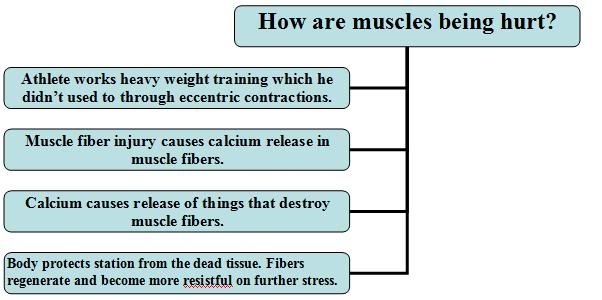
on muscle base can cause muscle fiber damage or metabolic fatique, like fuel
exhaustion, Ca++ outburst into the muscle or building intramuscular
hydrogen ions(pH).
Usually
metabolic overload mechanisms appear during extended submaximal phase or
intensive repeated short exercise. Complex muscle contraction cycle is intaked by neural impulse that
depolarizes surface membrane of muscle station, which result is action
potential(electrocharge), which is transferred to muscle fiber later. After
that there is a whole series of events where Ca++ is connected to protein fibers(actine and
myosin) which results by contractional tension.
Functional
side of fatique is relation between stimulus and contraction, which results by
intensity decrease of these two processes, or by sensibility decrease on
activations. Changes in
circulation of Ca++ ions
influents stimuli operation and contraction. Researchers came to the fact that
lactic acid raise in blood and muscles affect negatively to medium or
long-lasting performance and their assume is that is the word about causal
connection between local muscles fatique and lactic acid accumulation. Increased
acidose or lactic fatique, for which is thought to determine exhaustion point,
can weaken mechanical processes included into muscle contraction in four
possible ways:
1)Accumulation
of hydrogen ione influents positive energy production(ATP), by stopping
phosphofructokynase(PFK), enzyme that limits the speed of aerobic glycolyse.
Activities of other enzymes, like lactic dehydrogenesis(LDH), phosphorilasis
and myosin-ATPase are also limited
2)Increased
acidose decreases the oxygen ability to connect haemoglobine. Moreover, to stop
eventual low rate of oxygen on the muscle station, during its transport through
capilars haemoglobine will release even more oxygen.
3)Increased
acidose competes with troponine for connective places, by stopping connecting
of Ca++ for troponine. Cause
troponine is very important factor at muscle station contraction, its relative
inactivity can explain connection between fatique and exercise. Ca++ dropping also does that heart muscle is more
sensitive than skeletal muscle, which probably explains why it has such a
pressure on contractibility during acidose. Increased concentration of hydrogen
ions stops Ca++ releasing
from sarcoplasmatic reticulum.
4)Hydrogen
iones accumulation creats discomfort, which can be limiting factor in
psychological fatique and supercompensation.
From
energy composition view, fatique appears when it comes to creatine-phosphate
exhaustion in working muscle, when muscle glycogen is spared, and when
carbohydrate amounts are exhausted. Obvious result is work dropping, maybe
because ATP in muscle to which glycogen storage is emptied produces with lower
speed than spending. Expertises show that carbohydrates are crucial for muscle
ability to maintain high force.
Also, endurance capacity, during longer moderate to high body activity, is
related to amount of glycogen in muscle before exercise. That shows that
fatique is shown as a result of muscle glycogen consumption.
At
high intensity activity, but short term, energy substrates for muscle
contraction are ATP and CP. Completely emptying of these sources would surely
limit muscle ability to contract.
At
long-lasting submaximal work free fat acids and glucose secure energy. Liver
serves high amount of glucose. Limiting of free fat acids(through
beta-receptors block) can increase the speed of glycogen decrease, which
influents performance.
Oxidation
relies on oxygen availability which in limited amount oxydates carbohydrates
instead of free fat acids. Maximal
oxidation of free fat acids is though determined by the flow of free fat acids
into operating muscle and aerobic training athletes status, cause aerobic
training increases availability of oxygen and power of free fat acids
oxidation.
Metabolic
processes, like hypoxion(limited oxygen delivery into working muscle), which
results by changed ion concentration amount, ATP lowering and lactic acid
accumulation; can explain muscle damage. However, evidences show that it comes
to bigger structural damage when muscle is the subject of repeated eccentric or
concentric load. Eccentric contractions product more tension for the area of
active muscle cross section, than concentric contractions. Though eccentric contractions product bigger
structural loads, it has to be a lot of stress tension in repeated contractions
to cause the stoppage in tension of muscle fiber. Only then it will come to
rupture of muscle fibers structural components.
Model from the area of material fatique can
show why is the most effective way contractions repeating. Material that is the
subject of alternating excess and compression or relaxation will fail with
time. Speed of exhange determines how fast material will fatique. For the most
elastic materials, for fail is important the relation between stress and number
of power changing cycle. So, as stress increases, number of cycles till failure
decreases, We can also apply this access to muscle fibers that are constantly
the subject of work that easily overtakes the power of muscle structural
elements.
Heat
increases muscle contractions by increasing of muscle fibers sensitivity on Ca++ actions. That is the reason why athletes
shouldn’t go without warm-up before activity. Some evidences say that heat in
muscle during muscle contractions can lead to muscle damage. Eccentric muscle contractions generate more
thermal energy than concentric muscle work. During concentric muscle
contraction probably comes to heat increase due to decreased muscle ability to
remove heat, and not due to high production heat speed inside of muscle
station. Raise of intermuscular temperature explains 18% higher speed of lipids
and proteins structural degradation. That happens more often with negative than
with positive contractions. Speed in which contractions are made also influents
heat production.
Stop
of structural muscle components often leads to microtrauma. Discomfort isn’t
starting in the moment, but reaches its peak in 24-72 hours. For example, pain
of muscle brachioradialis is ranked with 1=normal – 10= extremely painful.
Measure is done before eccentric exercise of muscle brachioradialis and then
five days after exercise. Feeling that is often revived by athletes is boring dull
pain combined with localized sensitivity and stiffness. These feelings are
decreased inside 5-7 days after initial training. Example, this is one of
variances how pain should develop – day 1- 1, day 2- 5,5, day 3- 6,4, day 4-
6,5, day 5- 4,5, day 6- 4.
During muscle work force is transferred to the
bones through tendons. Fibers directly to muscle-tendon connections that form tendon
tissue are oriented on wavy, but scarpy way, which leaves them vulnerable to
high eccentric exercise tension. These
fibers are also less elastic than muscle tissue, which is one more reason to be
more accessible to injuries and localized pain.
Wavy configuration will disappear on tendon
stretched 4% of its length in rest phase. 4-8 percentage of colagene fybers
will slide each other once small ruptures appear inside of basic fibers. If
tendon is stretched 8-10% of its length for the time of rest, consequently more
fibers will be damaged. Damages appear on the weakest link of tendon. Damaged
tendons can be the consequence of following conditions:
Contraction done too fast.
Explosive movement.
Contraction done sideline.
Tendon is under tension
before load.
Attached muscle is maximally
innervated(under nerves influence). Muscle group around knee tendon is
highly innervated, which makes it more reliable to injuries.
Muscle group is stretched by
outer stimulus.
Tension is the consequence
of eccentric movements.
Tendon is weak compared to
muscle.
Damaged
tendons need a lot of time for regeneration. Researches say that it is due to limited
blood flow in that part of muscle.
For
years, lactic acid was emphasized as a factor for muscular pain. Through
sophisticated chemical tests and electronic microscopes, researchers found that
muscle pain is actually caused by muscle fibers damage as a consequence of Ca++ ione in muscle station.
Fast-hitch and slow-hitch fibers are subjected
to muscle damages caused by training. However, it was shown that bigger damages
are in fast-hitch fibers, primarily during eccentric and maximally concentric force
outgoing. Though there is no clear explanation for that difference, we can
prescribe it to the contraction type,
activity intensity, motor patterns of recruitment or structural differences
that exist between two sets of muscle fibers.
"Periodization, theory and
methodology of training", Tudor Bompa
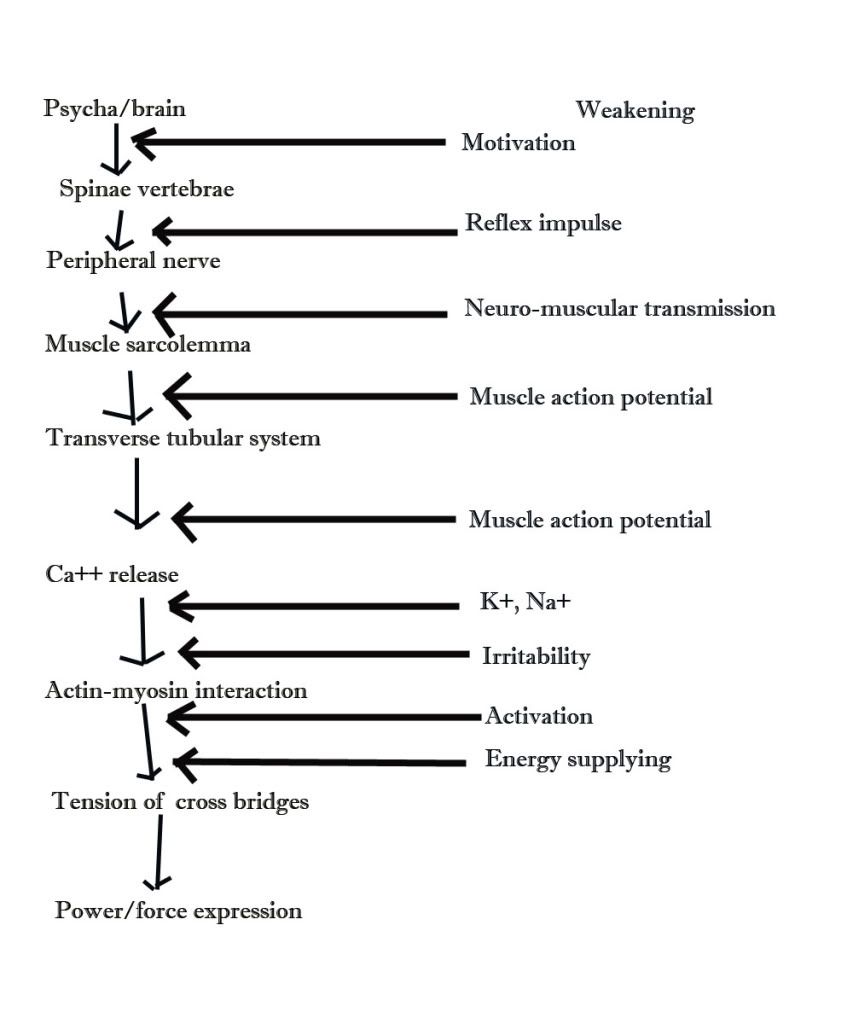
Numerous evidences are telling us that central
nervous system can be included into performance limitation in a lot bigger
measure than it was thought earlier. Fatique can include various processes that
are related to CNS commands or peripheral mechanisms.CNS fatique(long-term
overtrainness) causes motivation falling, weakened transmission along spinae
and weakened regrutation of motor neurons.Peripheral fatique(short-term
overtrainness) can include weakness in the function of peripheral nerves,
neuro-muscular connections, muscle fibers electrical activity or activation
process inside of muscle fibers.
Peripheral fatique can be divided into two
groups: high frequency fatique(electromechanic fatique) and low frequency
fatique(mechanic-metabolic fatique).
The greatest fatique conditions in soccer are
neural factors, ATP-CP mechanism exhaustion and lactic acidose.
Fatique
Features
Mechanisms
CNS
force or warm generated by voluntary excess
lower than electric stimulation
Failure to maintain power or frequency of
motor units
Peripheral
Same loss of force or heat generation caused
by voluntary and stimulated contractions
a.
High frequency
Selective force loss of high stimulation
frequencies
Weakened neuro-muscular transmission of muscle
actions potential
b.
Low frequency
Selective force loss of low stimulation
frequencies
Weakened irritability/ contraction
High frequency fatique is usually appeared in
the sports that last less than 60 seconds or little bit more than 60 seconds.
Outer force drops as a result of action potential failure(muscle membrane
ability to electrolyte electric signals) along surface membrane(sarcolemma) of
muscle station. Sarcolemma helps with electric signals transmission into holes
on the surface of muscle station(T-tubes) and on individual actin and myosin
fibers. Impossibility to spread electric signals(potentials of action) is due
to potassium agglomeration in T-tubes and space between actin and myosin
fibers. This fatique is shown in cold muscles, muscles that are not properly
heated.
Low frequency fatique is primarily caused by
station damages, specially connected to irregular contractions. Station damage
leaves muscle station in the condition of chaos. Station structure damages that
transmit electrosignals look like worn wires. As a consequence, electrosignals
are weak.
CNS has two processes – stimulus and
inhibition. Stimulus is wishful stimulating process for body activity.
Inhibition is limiting process. Training changes these two processes over and over.
At any stimuli CNS sends neural impuls to working muscle by ordering to make
contraction and do the work. Speed, power and frequency of neural impulses are
dependant of CNS condition. When controlled stimulus overcomes, neural impulses
are the most effective, which is shown by good performance. When, as a fatique
result, neural station is in the condition of inhibition, muscle contraction is
weak and slow. So, the power of contraction and number of motor units(muscle
fibers) that are directly included, are related to electric activation that is
sent by CNS. Neural station working capacity cannot be maintained for long. If
athlete maintains big intensity, neural station keeps the inhibition condition
to protect from outer stimuli. Once when came in that condition, neural station
isn’t responding in the same rate of activation. Force generated by working
muscle decreases cause some neural stations decrease its warming speed a lot
before the threshold value. That decreases number of included motor units.
If coach would neglect needs to change days of
high intensity training with days of low intensity training, new intensive
stimuli would result with exhaustion where neural station is in the inhibition
stadium. While in that condition, performance is worser. Emotional problems are
related to that type of behaviour. In
the end, training continuation under that amount will result with
overtrainness, when athlete is completely out of form.
Fast-hitch, fast glycolitic and fast oxidative
glycolitic fibers are a lot more sensitive to fatique than slow-hitch fibers.
Fast-hitch fibers have huge potential for fast return of Ca++ ion
and ATP-CP related to muscle contraction and for ATP-CP production through
anaerobic processes. However, slow-hitch fibers have higher aerobic potential
that is shown by bigger mioglobuline and mitochondrial enzyme amount of
activity.
Increased capacity of fatique tolerance.
Adaptation reactions created.
1-2 weeks
Acute amount of fatique. Rest periods
insufficient for compensation.
1 week
Athletes rely on motivation to win the
fatique pressure.
1 week
Inhibition, improper neural activation on
outer stimulus, performance starts to fall
1 week
Pressure to continue from coach, coplayers,
family and competitive schedule
2 weeks
Inhibition of protection. Neural station
protects from further stimuli. Performance falls. Injuries liability.
1 week
Athletes use the last sources of power and
will to continue training.
2 weeks
Overtrainness. Athletes are out of form.
Emotional problems. Injuries.
Skeletal muscle develops the force
progressively, by activating motor units and regulating its working frequency
that is progressively increased to achieve outer force. Slow-hitch muscle
fibers are included according to the size of their neuro-musclular units and
according to their dominant aerobic metabolism. When force demand is increased,
fast oxidative glycolitic fibers become bigger, after that fast glycolitic fibers
occur, and they can generate the size of force.
Fatique that inhibits muscle activity can be
neutralized by adjustment strategy with the power of motor units to exchange
work frequency. Muscle can more effectively keep the force under determined
fatique condition. But, if lasting of continuos muscle contraction is longer,
work frequency of motor units will decrease, in order to increase inhibition.
Some researches are saying that, compared to
beginning of work, and maximal voluntary contraction of 30 seconds, in the end
work frequency drops 80%!!!
This should warn the ones that promote theory
that force can be promoted only by working every set to the exhaustion. The
fact is that work frequency is dropping parallel with contraction progression,
discredits theory of every exhaustion set. As the contraction progresses, fuel
reserves are becoming lower and lower, which results by longer relaxation time
of motor unit and decreased frequency of muscle contraction. Assume is that
condition for that type of behaviour is fatique, so experts should be warned on
short rest periods. Standard 2 minutes between two sets of maximal contraction
are insufficient to regenerate neuro- muscular system to achieve high
activation in next sets.
"Periodization, theory and
methodology of training", Tudor Bompa
When
homeostatic body balance is disrupted, organism tries to adjust to maintain
balance. It is obligation that training regime enables adjustment stimulus to
the athlete, by exchanging rest periods with work periods. After some training
12-24 hours is needed for complete organism regeneration. To recover from
training that is inside the limits of an athlete adjustment, specific technique
regenerations have to be done and good progression of loads on training has to
be planned.
Avoid big load increases on training. Exposure
of an athlete to the high amounts of body stress out of their abilities or
non-proper rest will result by fall in new stress adjustment. If not adjusted
or if exposed on too big demands, fatique will occur and recovery from training
will not be possible. Follow athlete reactions on training, like shown in the
table under.
inattention, impossibility to correct moves,
intellectual concentration off
Training
and health status
performance of all assignments
muscle weakness, strength missing, decreased
work capacity
muscle and joints pain, headache and gastric
problems, weakness
sleeping problems, muscle pain, high cardio
rate even after 24 hours
Training
mood
Excellent
good will, but wish for longer recovery
complete rest needed, wish to stop training
abhorrence to training, negative view to
everything in training
To understand overtrainness well, few terms has
to be defined. Acute fatique with the
results of too big muscle tension after single training. This
type of fatique lasts very shortly, maybe one-two days or shorter, and usual
symptoms are muscle pain, restless sleep and increased reaction on alergents.
Overtrainness
with muscle tension is
caused by hitting microcycle and it is similar to acute fatique. However,
symptoms don’t last longer than two days. Symptoms include: resisting to
work, disrupted sleep, lack of apettite, unreasonable use of energy and
emotional disorders.
Overreaching(acute
fatique) is caused by one
or more intensive microcycles or by too short recovery period. That type of
fatique usually lasts from few days to two weeks. With this condition muscle
tension can and needn’t be connected. Symptoms are similar to overload. They
are more serious cause they include increased heart volume in the stadium of
inaction, increased heart rate and lactic acid concentration during submaximal
work, too early fatique, increased thirst, especially during night and worser
performance.
Overtrainness
syndrome is the result of
consecutive overexcessed microcycles with insufficient regeneration. That
fatique is long term and it lasts from few days to few months. During this
phase it comes to significant organic changes, mostly in the shape of
distrophia. This condition can and needn’t be followed by muscular tension.
As symptoms numerously grow, seriousness and
complexity of this symptoms is being increased. Symptoms that are related with
stimulus will vary depending on intensity.
1) Nadji Slovak pod poljem Dynamic translation.
2) Sacekati da ucita prevod.
3) Ponovo aktivirati padajuci meni, Serbian ce se pojaviti tacno iznadSlovak.
4) Kliknuti na Serbian.
All of our methods and training programs are based on scientific researches and confirmations! We follow the science! We follow the latest methods and trends! We adjust programs according to our players bio, conditions, requests, needs, progression. We always make a deal. We never do the same type of training for all the players.





 Serbian Dinar Exchange Rate