Free Facebook Likes, Youtube Subscribers,  Twitter Followers

Ads 468x60px

Blogger Tricks

Blogger Themes

5. 7. 2012.

Adaptations to aerobic training - part IV


 PART I
 PART II
 PART III

What limits aerobic power and endurance performance?

A number of years ago, exercise scientists were divided on what major physiological factor or factors actually limit VO2max. Two contrasting theories had been proposed.
One theory held that endurance performance was limited by the lack of sufficient concentrations of oxidative enzymes in the mitochondria. Endurance training programs substantially increase these oxidative enzymes, allowing active tissue to use more of the available oxygen, resulting in a higher VO2max. In addition, endurance training increases both the size and number of muscle mitochondria. Thus, this theory argued, the main limitation of maximal oxygen consumption is the inability of the existing mitochondria to use the available oxygen beyond a certain rate. This theory was referred to as the utilization theory.
The second theory proposed that central and peripheral circulatory factors limit endurance capacity. These circulatory factors would preclude delivery of sufficient amounts of oxygen to the active tissues. According to this theory, improvement in VO2max following endurance training results from increased blood volume, increased cardiac output(via stroke volume), and a better perfusion of active muscle with blood.
Evidence strongly supports the latter theory. In one study, subjects breathed a mixture of carbon monoxide(which irreversibly binds to hemoglobin, limiting hemoglobin’s oxygen-carrying capacity) and air during exercise to exhaustion. VO2max decreased in direct proportion to the percentage of carbon monoxide breathed. The carbon monoxide molecules bonded to approximately 15% of the total hemoglobin; this percentage agreed with the percentage reduction in VO2max. In another study, approximately 15% to 20% of each subject’s total blood volume was removed. VO2max decreased by approximately the same relative amount. Reinfusion of the subjects’ packed red blood cells approximately four weeks later increased VO2max well above baseline or control conditions. In both studies, the reduction in the oxygen-carrying capacity of the blood – via either blocking hemoglobin or removing whole blood – resulted in the delivery of less oxygen to the active tissues and a corresponding reduction in VO2max. Similarly, studies have shown that breathing oxygen-enriched mixtures, in which the partial pressure of oxygen in the inspired air is substantially increased, increases endurance capacity.
These and subsequent studies indicate that the available oxygen supply is the major limiter of endurance performance. Saltin and Rowell reviewed this topic and concluded that oxygen transport to the working muscles, not the available mitochondria and oxidative enzymes, limits VO2max. They argued that increases in VO2max with training are largely attributable to increased maximal blood flow and increased muscle capillary density in the active tissues. The major skeletal muscle adaptations(including increased mitochondrial content and respiratory capacity of the muscle fibers) appear more closely related to the ability to perform prolonged, high-intensity, submaximal exercise.
Table below summarizes the expected physiological changes that occur with endurance training. The changes pre- to posttraining in a previously inactive man are compared with values for a world-class male endurance runner.

Expected effects of endurance training in a previously inactive man along with values for a male world-class endurance athlete

Sedentary male subject
Variables
Pretraining
Posttraining
World Class runner
75
65
45
185
183
174
60
70
100
120
140
200
4.5
4.5
4.5
22.2
25.6
34.8
Heart volume(ml)
750
820
1.200
Blood volume(L)
4.7
5.1
6.0
135
130
120
200
210
220
78
76
65
82
80
65
Respiratory
7
6
6
110
135
195
0.5
0.5
0.5
2.75
3.0
3.9
5.8
6.0
6.2
1.4
1.2
1.2
Metabolic
6.0
6.0
6.0
14.5
15.0
16.0
3.5
3.5
3.5
40.7
49.9
81.9
Blood lactate at rest(mmol/L)
1.0
1.0
1.0
Blood lactate max(mmol/L)
7.5
8.5
9.0
Body composition
Weight(kg)
79
77
68
Fat weight(kg)
12.6
9.6
5.1
Fat-free weight(kg)
66.4
67.4
62.9
Fat(%)
16.0
12.5
7.5

VO2  = oxygen consumption
HR = heart rate
SV = stroke volume
Q = cardiac output
BP = blood pressure
VE = ventilation
TV = tidal volume
VC = vital capacity
RV = residual volume
(a-ṽ)O2 diff = arterial-mixed venous oxygen difference


 Long-term improvement in aerobic power and cardiorespiratory endurance

Although an individual’s highest attainable VO2max is usually achieved within 12 to 18 months or intense endurance conditioning, endurance performance continues to improve with continued training for many additional years. Improvement in endurance performance without improvement in VO2max is likely attributable to improvements in the ability to perform at increasingly higher percentages of VO2max for extended periods.
Consider, for example, a young male runner who starts training with an initial VO2max of 52.0 ml x kg-1 x min-1. He reaches his genetically determined peak VO2max of 71.0 ml x kg-1 x min-1 after two years of intense training, after which no further increases occur, even with more frequent of more intense workouts. At this point, as shown in the figure below, the young runner is able to run at 75% of his VO2max(0.75 x 71.0 = 53.3 ml x kg-1 x min-1) in a 10km(6.2mi) race. After an additional two years of intensive training, his VO2max is unchanged, but he is now able to compete at 88% of his VO2max(0.88 x 71.0 = 62.5 ml x kg-1 x min-1). Obviously, by being able to sustain an oxygen uptake of 62.5 ml x kg-1 x min-1, he is able to run at a much faster race pace.


This ability to sustain exercise at a higher percentage of VO2max is the result of an increase in the ability to buffer lactate, because race pace is directly related to the VO2 value at which lactate begins to accumulate.

Factors affecting individual response to aerobic training

Level of conditioning and VO2max

The higher the initial state of conditioning, the smaller the relative improvement for the same program of training. For example, if two people, one sedentary and the other partially trained, undergo the same endurance training program, the sedentary person will show the greatest relative improvement.
In fully mature athletes, the highest attainable VO2max is reached within 8 to 18 months of heavy endurance training, indicating that each athlete has a finite maximal attainable level of oxygen consumption. This finite range may potentially be influenced by training in early childhood during the development of the cardiovascular system.

Heredity

The ability to increase maximal oxygen consumption levels is genetically limited. This does not mean that each individual has a preprogrammed VO2max that cannot be exceeded. Rather, a range of VO2max values seems to be predetermined by an individual’s genetic makeup, and that individual’s highest attainable VO2max should fall in that range. Each individual is born into a predetermined genetic window, and that individual can shift up or down within that window with exercise training or detraining, respectively.
Research into the genetic basis of VO2max began in the late 1960s and early 1970s. Recent research has shown that identical(monozygous) twins have similar VO2max values, whereas the variability for dizygous(fraternal) twins is much greater. Figure below illustrates this. Each symbol represents a pair of brothers. Brother A’s VO2max value is indicated by the symbol’s position on the x-axis, and brother B’s VO2max value is on the y-axis. Similarly in the siblings’ VO2max values is noted by comparing the x and y coordinates of the symbol(i.e. how close it falls to the diagonal line x=y on the graph). Similar results were found for endurance capacity, determined by the maximal amount of work performed in an all-out, 90 min ride on a cycle ergometer.


Bouchard and colleagues’ concluded that heredity accounts for between 25% and 50% of the variance in VO2max values. This means that of all factors influencing VO2max, heredity alone is responsible for one-quarter to one-half of the total influence. World-class athletes who have stopped endurance training continue for many years to have high VO2max values in their sedentary, deconditioned state. Their VO2max values may decrease from 85 to 65ml x kg-1 x min-1, but this deconditioned value is still very high.
Heredity also potentially explains the fact that some people have relatively high VO2max values yet have no history of endurance training. In a study that compared untrained men who had VO2max values below 49 ml x kg-1 x min-1 with untrained men who had VO2max values above 62.5 ml x kg-1 x min-1, those with high values were distinguished by having higher blood volume values, leading to higher stroke volume and cardiac output values at maximal rates of exercise. The higher blood volumes in the high VO2max group were possibly genetically determined.
Thus, both genetic and environmental factors influence VO2max values. The genetic factors probably establish the boundaries for the athlete, but endurance training can push VO2max to the upper limit of these boundaries. Dr. Per-Olof Astrand, one of the most highly recognized exercise physiologists during the second half of the 20th century, stated on numerous occasions that the best way to become a champion Olympic athlete is to be selective when choosing one’s parents!

Sex

Healthy untrained girls and women have significantly lower VO2max values(20-25% lower) than healthy untrained boys and men. Highly conditioned female endurance athletes have values much closer to those of highly trained male endurance athletes(i.e., only about 10% lower).

High responders and low responders

For years, researchers have found wide variations in improvement of VO2max with aerobic training. Studies have demonstrated individual improvements in VO2max ranging from 0% to 50% or more, even in similarly fit subjects completing exactly the same training program.
In the past, exercise physiologists have assumed that these variations result from differing degrees of compliance with the training program. Good compliers should have the highest percentage of improvement, and poor compliers should show little or no improvement – and that certainly is the case. However, given the same training stimulus and full compliance with the program, substantial variations occur in the percentage improvements in VO2max values of different people.
It is now evident that the response to a training program is also genetically determined. This is illustrated in figure below. Ten pairs of identical twins completed a 20-week endurance training program; the improvements in VO2max, expressed as percentages, are plotted for each twin pair – Twin A on the x-axis and Twin B on the y-axis. Notice the similarity in response for each twin pair. Yet across twin pairs, improvement in VO2max varied 0% to 40%. These results, and those from other studies, indicate that there will be high responders(large improvement) and low responders(little or no improvement) among groups of people who participate in identical training programs.


Results from the HERITAGE Family Study also support a strong genetic component affecting the magnitude of increase in VO2max with endurance training. Families, including the natural mother and father and week for 20 weeks, initially exercising at a heart rate equal to 55% of their VO2max for 35 min per day and progressing to a heart rate equal to 75% of their VO2max for 50 min per day by the end of the 14th week, which they maintained for the last six weeks. The average increase in VO2max was about 17% but varied from 0% to more than 50%. Figure below illustrates the improvement in VO2max for each subject in each family. Maximal heritability was estimated at 47%. Note that subjects who are high responders tend to be clustered in the same families as those who are low responders.


It is clear that this is a genetic phenomenon, not a result of compliance or noncompliance. One must consider this important point when conducting training studies and designing training programs. Individual differences must be accounted for.

Cardiorespiratory endurance and performance

Many people regard cardiorespiratory endurance as the most important component of physical fitness. It is an athlete’s major defense against fatique. Low endurance capacity leads to fatique, even in the more sedentary sports or activities. For any athlete, regardless of the sport or activity, fatique represents a major deterrent to optimal performance. Even minor fatique can hinder the athlete’s total performance:
  • Muscular strength is decreased.
  • Reaction and movement times are prolonged.
  • Agility and neuromuscular coordination are reduced.
  • Whole-body movement speed is slowed.
  • Concentration and alertness are reduced.

The decline in concentration and alertness associated with fatique is particularly important. The athlete can become careless and more prone to serious injury, especially in contact sports. Even though these decrements in performance might be small, they can be just enough to cause an athlete to miss the critical free throw in basketball, the strike zone in baseball, or the 20ft(6m) putt in golf.
All athletes can benefit from maximizing their endurance. Even golfers, whose sport is relatively sedentary, can improve. Improved endurance can allow golfers to complete a round of golf with less fatique and to better withstand long periods of walking and standing.
For the sedentary, middle-aged adult, numerous health factors indicate that cardiovascular endurance should be the primary emphasis of training.
The extent of endurance training needed varies considerably from one athlete to the next. It depends on the athlete’s current endurance capacity and the endurance demands of the chosen activity.The marathon runner uses endurance training almost exclusively, with limited attention to strength, flexibility and speed. The baseball player, however, places very limited demands on endurance capacity, so endurance conditioning is not as highly emphasized. Nevertheless, baseball players could gain substantially from endurance running, even if only at a moderate pace for 5km(3.1 mi) per day, three days a week. As a benefit, baseball players would have little or no leg trouble(a frequent complaint), and they would be able to complete a doubleheader with little or no fatique.
Adequate cardiovascular conditioning must be the foundation of any athlete’s general conditioning program. Many athletes in nonendurance activities never incorporate even moderate endurance training into their training programs. Those who have done so are well aware of their improved physical condition and its impact on their athletic performance.


Euro 2012 • Top 10 Goals


Adaptations to aerobic training - part III


Respiratory adaptations to training

No matter how adept the cardiovascular system is at supplying adequate amounts of blood to tissues, endurance would be hindered if the respiratory system were not able to bring in enough oxygen to meet oxygen demands. Respiratory system function does not usually limit performance because ventilation can be increased to a much greater extent than cardiovascular function. But, as with the cardiovascular system, the respiratory system undergoes specific adaptations to endurance training to maximize its efficiency.


After training, pulmonary ventilation is essentially unchanged at rest. Although endurance training does not change the structure of basic psychology of the lung, it does decrease ventilation during submaximal exercise by as much as 20% to 30% at a given submaximal intensity. Maximal pulmonary ventilation is substantially increased from a rate of about 100 to 120L/min in untrained sedentary individuals to about 130 to 150L/min or more following endurance training. Pulmonary ventilation rates typically increase to about 180L/min in highly trained athletes and can exceed 200L/min in very large, highly trained endurance athletes. Two factors can account for the increase in maximal pulmonary ventilation following training: increased tidal volume and increased respiratory frequency at maximal exercise.
Ventilation is usually not considered a limiting factor for endurance exercise performance. However, some evidence suggests that at some point in a highly trained person’s adaptation, the pulmonary system’s capacity for oxygen transport may not be able to meet the demands of the limbs and the cardiovascular system. This results in what has been termed exercise-induced arterial hypoxemia, in which arterial oxygen saturation decreases below 96%. This desaturation in highly trained athletes likely results from the large right heart cardiac output directed to the lung during exercise and consequently a decrease in the time the blood spends in the lung.


Pulmonary diffusion, or gas exchange occurring in the alveoli, is unaltered at rest and at standardized submaximal exercise intensities following training. However, it increases during maximal exercise. Pulmonary blood flow(blood coming from the heart to the lungs) appears to increase following training, particularly the flow to the upper regions of the lungs when a person is sitting or standing. This increases lung perfusion. More blood is brought into the lungs for gas exchange, and at the same time ventilation increases to that more air is brought into the lungs. This means that more alveoli will be involved in pulmonary diffusion. The net result is that pulmonary diffusion increases.


The oxygen content of arterial blood changes very little with endurance training. Even though total hemoglobin is increased, the amount of hemoglobin per unit of blood is the same or even slightly reduced. The (a-ṽ)O2 difference, however, does increase with training, particularly at maximal exercise intensity. This increase results from a lower mixed venous oxygen content, which means that the blood returning to the heart(which is a mixture of venous blood from all body parts, not just the active tissues) contains less oxygen than it would in an untrained person. This reflects both greater oxygen extraction at the tissue level and a more effective distribution of blood flow to active tissue. The increased extraction results in part from an increase in oxidative capacity of active muscle fibers.
In summary, the respiratory system is quite adept at bringing adequate oxygen into the body. For this reason, the respiratory system seldom limits endurance performance. Not surprisingly, the major training adaptations noted in the respiratory system are apparent mainly during maximal exercise, when all systems are being maximally stressed.

Adaptations in muscle

Repeated use of muscle fibers with endurance training stimulates changes in their structure and function. Our main interest here is in aerobic training and the changes it produces in muscle fiber type, mitochondrial function, and oxidative enzymes.

Muscle fiber types

Aerobic activities such as jogging and low-to moderate-intensity cycling rely extensively on the slow-twitch(type I) fibers. In response to aerobic training, type I fibers become larger. That is, they develop a larger cross-sectional area, although the magnitude of change depends on the intensity and duration of each training bout and the length of the training program. Increases of up to 25% have been reported. Fast-twitch(type II) fibers, because they are not being recruited to the same extent, generally do not increase cross-sectional area.
Most early studies showed no change in the percentage of type I and type II fibers following aerobic training, but subtle changes were noted among type II fiber subtypes. Type IIx fibers are used less often than IIa fibers, and for that reason they have a lower aerobic capacity. Long-duration exercise may eventually recruit these fibers into action, demanding them to perform in a manner normally expected on the IIa fibers. This can cause some IIx fibers to take on the characteristics of the more oxidative IIa fibers. Recent evidence suggests that not only is there a transition of type IIx to IIa fibers, but there can also be a transition of type II to type I fibers. The magnitude of change is generally small, not more than a few percentage points. As an example, in the HERITAGE Family Study, a 20-week program of aerobic training increased type I fibers from 43.2% pretraining to 46.7% posttraining and decreased type IIx fibers from 20.0% to 15.1%, with type IIa remaining essentially unchanged. These more recent studies have included larger numbers of subjects and have taken advantage of improved measurement technology; both might explain why changes are now being recognized.

Capillary supply

One of the most important adaptations to aerobic training is an increase in the number of capillaries surrounding each muscle fiber. Endurance-trained men have considerably more capillaries in their leg muscles than sedentary individuals. With long periods of aerobic training, the number of capillaries has been shown to increase by more than 15%. Having more capillaries allows greater exchange of gases, heat, wastes, and nutrients between the blood ad working muscle fibers. In fact, the increase in capillary density(i.e. increase in capillaries per muscle fiber) is potentially one of the most important alterations in response to training that allows the increase in VO2max. It is now clear that the diffusion of oxygen from the capillary to the mitochondria is a major factor limiting the maximal rate of oxygen consumption. Increasing capillary density facilitates this diffusion, thus maintaining an environment well suited to energy prediction and repeated muscle contractions.

Myoglobin content

When oxygen enters the muscle fiber, it binds to myoglobin, a compound similar to hemoglobin. This iron-containing compound shuttles the oxygen molecules from the cell membrane to the mitochondria. The type I fibers contain large quantities of myoglobin, which gives these fibers their red appearance(myoglobin is a pigment that turns red when bound to oxygen). The type II fibers , on the other hand, are highly glycolitic, so they require(and have) little myoglobin-hence their whiter appearance. More important, their limited myoglobin supply limits their oxygen capacity, resulting in poor aerobic endurance for these fibers.
Myoglobin stores oxygen and releases it to the mitochondria when oxygen becomes limited during muscle action. This oxygen reserve is used during the transition form rest to exercise, providing oxygen to the mitochondria during the lag between the beginning of exercise and the increased cardiovascular delivery of oxygen.
Myoglobin’s precise contributions to oxygen delivery are not yet fully understood. But aerobic training has been shown to increase muscle myoglobin content to 75% to 80%. This adaptation would be expected only if myoglobin enhances a muscle’s capacity for oxidative metabolism.

Mitochondrial function

Aerobic(oxidative) energy production takes place in the mitochondria. Not surprisingly, then, aerobic training also induces changes in mitochondrial function that improve the muscle fibers’ capacity to produce ATP. The ability to use oxygen and produce ATP via oxidation depends on the number and size of the muscle mitochondria. Both increase with aerobic training.
During one study that involved endurance training in rats, the actual number of mitochondria increased approximately 15% during 27 weeks of exercise. Average mitochondrial size also increased by about 35% over that training period. As the volume of aerobc training increases, so do the number and size of the mitochondria.

Oxidative enzymes

Regular endurance exercise has been shown to induce major adaptations in skeletal muscle, including an increase in the number and size of the muscle fiber mitochondrial capacity. The oxidative breakdown of fuels and the ultimate production of ATP depend on the action of mitochondrial oxidative enzymes, the special proteins that catalyze(i.e., speed up) the breakdown of nutrients to form ATP. Aerobic training increases the activity of these important enzymes.
Figure below illustrates the changes in the activity of succinate dehydrogenase(SDH), a key muscle oxidative enzyme, over seven months of gradually increased swim training. While the increases in VO2max leveled off after the first two months of training, activity of this key oxidative enzyme continued to increase throughout the entire training period. This suggests that VO2max might be more influenced by the circulatory’s system limitations with respect to transporting oxygen than by the muscles’ oxidative potential.


The activities of muscle enzymes such as SDH and citrate synthase are dramatically influenced by aerobic training. This is seen in figure below, which compares the activities of these enzymes in untrained people, moderately trained joggers, and highly trained runners. Even moderate amounts of daily exercise increase these enzyme activities and thus the muscles aerobic capacity. For example, jogging or cycling for as little as 20 min per day has been shown to increase SDH activity in leg muscles by more than 25%. Training more vigorously, for example for 60 to 90 min per day, produces a two-to threefold increase in this activity.


One metabolic consequence of mitochondrial changes induced by aerobic training is glycogen sparing, a slower rate of utilization of muscle glycogen and enhanced reliance on fat as fuel source at a given exercise intensity. This increase in the oxidative enzymes with aerobic training most likely improves the ability to sustain a higher exercise intensity, such as maintaining a faster race pace in a 10km run.

Metabolic adaptations to training

Three important variables are related to metabolism:
  • Lactate threshold
  • Respiratory exchange ratio
  • Oxygen consumption.

Lactate threshold

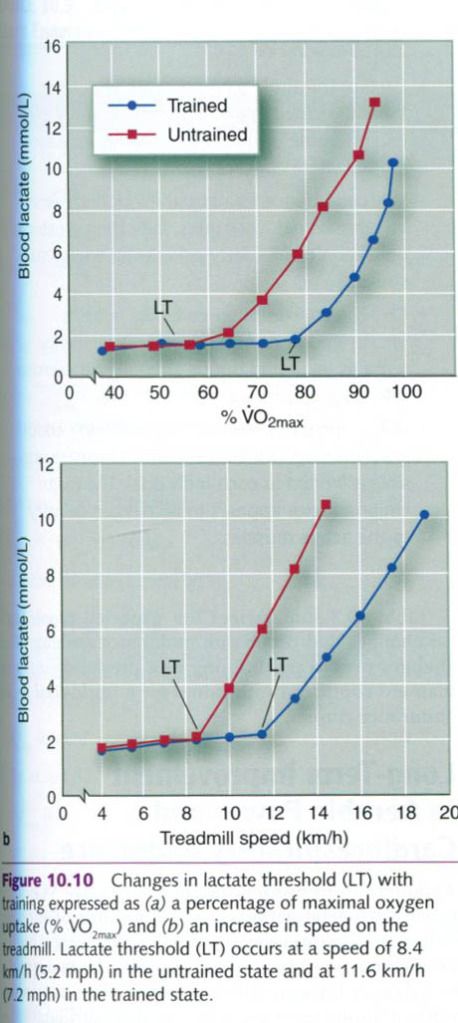
Lactate threshold is a psychological marker that is closely associated with aerobic endurance performance – the higher the lactate threshold, the better the aerobic performance. Figure a below illustrates the difference in lactate threshold that would occur following a 6 to 12-month program of endurance training. In either case, in the trained state, one can exercise at a higher percentage of one’s VO2max before lactate begins to accumulate in the blood. Because race pace in aerobic endurance events is closely associated with lactate threshold, this translates into a much faster race pace(see figure b). The reduction in lactate values at a given rate of work to likely attributable to a combination of reduced lactate production and increased lactate clearance.


The concentration of lactate in the blood following a fixed-pace swim or run provides an excellent means of monitoring the physiological changes that occur with training. As athletes become better trained, their blood lactate concentrations are lower for the same rate of work. This suggests that they are developing greater aerobic power, a reduced reliance on the glycolytic system for energy, or perhaps both.


The respiratory exchange ratio(RER) is the ratio of carbon dioxide released to oxygen consumed during metabolism. The RER reflects the type of substrates being used as an energy source.
After training, the RER decreases at both absolute and relative submaximal exercise intensities. These changes are attributable to a greater utilization of free fatty acids instead of carbohydrate at these work rates following  training.

Resting and submaximal oxygen consumption

Oxygen consumption(VO2) at rest is unchanged following endurance training. While a few cross-sectional comparisons have suggested that training elevates resting VO2, the HERITAGE FAMILY STUDY – with a large number of subjects and with duplicate measures of resting metabolic rate both before and after 20 weeks of training – showed no evidence of an increased resting metabolic rate after training.
During submaximal exercise at a given exercise intensity, VO2 is either unchanged or slightly reduced following training. In the HERITAGE Family Study, with more than 700 participants, training reduced submaximal VO2 by 3.5% at a work rate of 50W. There was a corresponding reduction in cardiac output at 50W, reinforcing the strong interrelationship between VO2 and cardiac output. A decrease in VO2 during submaximal exercise could result from an increase in exercise economy(performing the same exercise intensity with less extraneous movement).

Maximal oxygen consumption

VO2max is the best indicator of cardiorespiratory endurance capacity and increases substantially in response to endurance training. While small and very large increases have been reported, an increase of 15% to 20% is typical for a previously sedentary person who trains at 50% to 85% of his or her VO2max three to five times per week, 20 to 60 min per day, for six months. For example, the VO2max of a sedentary individual could reasonably increase from a 35ml x kg-1 x min-1 to 42ml x kg-1 x min-1 as a result of such a program. This is far below the values we see in world-class endurance athletes, whose values generally range from 70 to 94ml x kg-1 x min-1. The more untrained an individual is when starting an exercise program, the larger the increase in VO2max.

3. 7. 2012.

Adaptations to aerobic training – part II


Heart rate

Aerobic training has a major impact on heart rate at rest, during submaximal exercise, and during the postexercise recovery period. The effect of aerobic training on maximal heart rate is not as clear.

Resting heart rate

The heart rate at rest can decrease markedly as a result of endurance training. A sedentary individual with an initial resting heart rate of 80 beats/min can decrease resting heart rate by approximately 1 beat/min with each week of aerobic training, at least for the first few weeks. After 10 weeks of moderate endurance training, resting heart rate can decrease from 80 to 70 beats/miin or lower. The actual mechanisms responsible for this decrease are not entirely understood, but training appears to increase parasympathetic activity in the heart while decreasing sympathetic activity. It is important to recognize that several well-controlled studies with large numbers of subjects have shown much smaller decreases in resting heart rate, that is, fewer than 5 beats/min following up to 20 weeks of aerobic training.
Bradycardia is a clinical term indicating a heart rate of fewer than 60 beats/min. In untrained individuals, bradycardia is usually the result of abnormal cardiac function or a diseased heart. Therefore, it is necessary to differentiate between training-induced bradycardia, which is a natural response to endurance training, and pathological bradycardia, which can be a serious cause for concern.

Submaximal heart rate

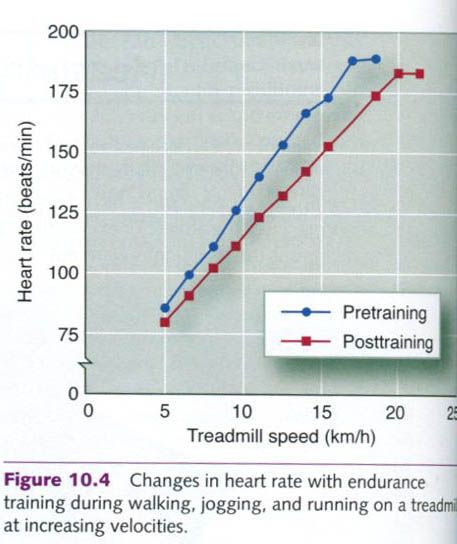
During submaximal exercise, aerobic conditioning results in proportionally lower heart rates at a given absolute exercise intensity. This is illustrated in figure below, which shows the heart rate of an individual exercising on a treadmill both before and after training. At each specified intensity, indicated here by the speed at which the subject is walking or running, the posttraining heart rate is lower than the heart rate before training. After a six-month endurance training program of moderate intensity, decreases in heart rate of 10 to 30 beats/min are common at the same absolute submaximal workload, the training-induced decrease being greater at higher intensities.


These decreases indicate that the heart becomes more economical through training. In carrying out its necessary functions, a trained heart performs less work(lower heart rate, higher stroke volume) than an unconditioned heart at the same absolute workload.

Maximum heart rate

A person’s maximal heart rate(HRmax) tends to be stable and typically remains relatively unchanged after endurance training. However, several studies have suggested that for people whose untrained HRmax values exceed 180 beats/min, HRmax might be slightly lower after training. Also, highly conditioned endurance athletes tend to have lower HRmax values than untrained individuals of the same age, although this is not always the case. Athletes over 60 years old sometimes have higher HRmax values than untrained people of the same age.

Interactions between heart rate and stroke volume

During exercise, the product of heart rate and stroke volume provides a cardiac output appropriate to the intensity of the activity being performed. At maximal or near-maximal intensities, heart rate may change to provide the optimal combination of heart rate and stroke volume to maximize cardiac output. If heart rate is too fast, diastolic filling time is reduced, and stroke volume might be compromised. For example, if HRmax is 180 beats/min, the heart beats three times per second. Each cardiac cycle thus lasts for only 0.33s. Diastole is as short as 0.15s or less. This fast heart rate allows very little time for the ventricles to fill. As a consequence, stroke volume may decrease at high heart rates at which filling time is compromised.
However, if the heart rate slows, the ventricles would have longer to fill. This has been proposed as the reason highly trained endurance athletes tend to have lower HRmax values: their hearts have adapted to training by drastically increasing their stroke volumes, so lower HRmax values can provide optimal cardiac output.
Which comes first? Does increased stroke volume result in a decreased heart rate, or does a lower heart rate result in an increased stroke volume? This question remains unanswered. In either case, the combination of increased stroke volume and decreased heart rate is a more efficient way for the heart to meet the metabolic demands of the body, especially during exercise. The heart expends less energy by contracting less often but more forcefully than it would if contraction frequency were increased. Reciprocal changes in heart rate and stroke volume in response to training share a common goal: to allow the heart to pump the maximal amount of oxygenated blood at the lowest energy cost.

Heart rate recovery

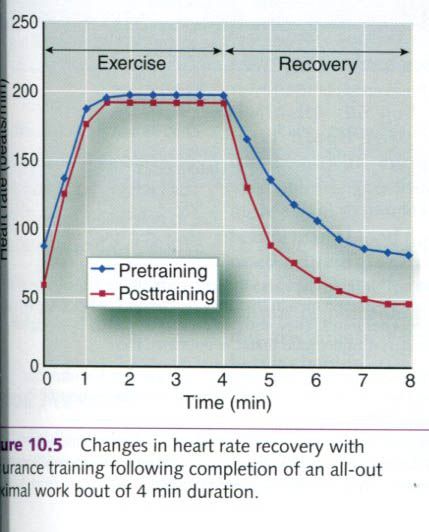
During exercise, heart rate must increase to increase cardiac output to meet the blood flow demands of active muscles. When the exercise bout is finished, heart rate does not instantly return to its resting level. Instead, it remains elevated for a while, slowly returning to its resting rate. The time it takes for heart rate to return to its resting rate is called the heart rate recovery period.
Following a period of training, as shown in the figure below, heart rate returns to its resting level much more quickly after exercise than it does before training. This is true after standardized submaximal exercise as well as after maximal exercise.


Because the heart rate recovery period is shortened after endurance training, this measurement has been proposed as an indirect index of cardiorespiratory fitness. In general, a more fit person recovers faster after a standardized rate of work than a less fit person, so this measure may have some utility in field settings when more direct measures of endurance capacity are not possible or feasible. However, factors other than training can also affect heart rate recovery time. For example, exercise in hot environments or at high altitudes can prolong heart rate elevation. Some people undergo a stronger sympathetic nervous system response during exercise than others, and this also could prolong heart rate elevation.
The heart rate recovery curve is a useful tool for tracking a person’s progress during a training program. But because of the potential influence of other factors, it should not be used to compare between individuals.

Cardiac output

While stroke volume increases, heart rate generally decreases at rest and during exercise at a given absolute intensity.
Because the magnitude of these reciprocal changes is similar, cardiac output at rest and during submaximal exercise at a given exercise intensity does not change much following endurance training. In fact, cardiac output can decrease slightly. This is likely the result of an increase in the (a-ṽ)O2 difference(reflecting greater oxygen extraction by the tissues) or a decrease in the rate of oxygen consumption(reflecting an increased mechanical efficiency). Generally, cardiac output matches the oxygen consumption required for any given intensity of effort.
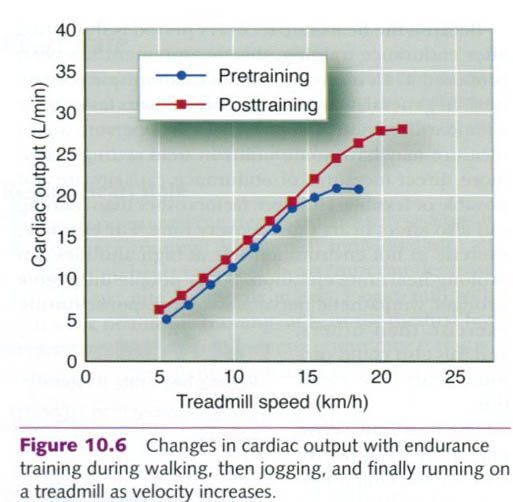
Maximal cardiac output, however, increases considerably at maximal exercise intensity in response to aerobic training, as seen in the figure below, and is largely responsible for the increase in VO2max. This increase in cardiac output must result from an increase in maximal stroke volume, because HRmax changes little, if any. Maximal cardiac output ranges from 14 to 20L/min in untrained individuals and from 25 to 35L/min in trained individuals, and can be 40L/min or more in highly conditioned endurance athletes. These absolute values, however, are greatly influenced by body size.


Blood flow

Active muscles need considerably more oxygen and nutrients than inactive ones. To meet these increased needs, more blood must be delivered to these muscles during exercise. With endurance training, the cardiovascular system adapts to increase blood flow to exercising muscles to meet their higher demand for oxygen and metabolic substrates. Four factors account for this enhanced blood flow to muscle following training:
  • Increased capillarization of trained muscles
  • Greater recruitment of existing capillaries in trained muscles
  • More effective blood flow redistribution from inactive regions
  • Increased blood volume.

To permit increased blood flow, new capillaries develop in trained muscles. This allows the blood flowing into skeletal muscle from arterioles to more fully perfuse the active tissues. This increase in capillaries usually is expressed as an increase in the number of capillaries per muscle fiber, or the capillary-to-fiber ratio. Table below illustrates the differences in capillary-to-fiber ratios between well-trained and untrained men, both before and after exercise.

Muscle fiber capillarization in well-trained and untrained men

Capillaries per mm2
Muscle fibers per mm2
Capillary-to-
fiber ratio
Diffusion
distance
Well trained
Preexercise
640
440
1.5
20.1
Postexercise
611
414
1.6
20.3
Untrained
Preexercise
600
557
1.1
20.3
Postexercise
599
576
1.0
20.5

Diffusion distance is expressed as the average half-distancce between capillaries on the cross-sectional view expressed in micrometers.

Not all capillaries are open at any given time in tissues, including muscle. In addition to new capillarization, existing capillaries in trained muscles can be recruited and open to flow, which increases blood flow to muscle fibers. The increase in new capillaries with endurance training and increased capillary recruitment combine to increase the cross-sectional area for exchange between the vascular system and the metabolically active muscle fibers. Because endurance training also increases blood volume, shifting more blood into the capillaries will not severely compromise venous return.
A more effective redistribution of cardiac output also can increase blood flow to the active muscles. Blood flow is directed to the active musculature and shunted away from areas that do not need high flow. Blood flow can increase to the more active fibers even within a specific muscle group. Armstrong and Laughlin demonstrated that endurance-trained rats could redistribute blood flow to their most active tissues during exercise better untrained rats could. The researchers used radiolabeled microspheres, radioactive particles that are injected into the bloodstream. The distribution of these microspheres was then determined by using a Geiger counter, which measures of the amount of radioactive material throughout the area of interest(in this case exercising muscle). The total blood flow to the hindlimbs did not differ between the trained and untrained rats during exercise. However, the trained rats distributed more of their blood to the most oxidative muscle fibers, effectively redistributing the blood flow away from the glycolitic muscle fibers. These findings are difficult to replicate in humans because of the technical difficulty(microspheres cannot be used in humans) of measuring blood flow to specific muscle types, as well as the fact that human skeletal muscle is a mosaic with mixed fiber types among individual muscles.
Finally, the body’s total blood volume increases with endurance training, providing more blood to meet body’s many blood flow needs during endurance activity.

Blood pressure

Following endurance training, arterial blood pressure is reduced at a given submaximal exercise intensity; but at maximal exercise capacity, systolic blood pressure is increased and diastolic pressure is decreased. Resting blood pressure in response to endurance training does not change significantly in healthy subjects but is generally lowered in borderline or moderately hypertensive individuals. This reduction occurs in both systolic and diastolic blood pressure. Drops in blood pressure average approximately 6 to 7mmHg for both systolic and diastolic pressure in hypertensive subjects and slightly less in borderline hypertensives. The mechanisms underlying this reduction are unknown.
Although resistance-type exercise can cause large increases in both systolic and diastolic blood pressure during lifting or heavy weights, chronic exposure to these high pressures does not elevate resting blood pressure. Hypertension is not common in competitive weightlifters or in strength and power athletes. In fact, a few studies have even shown that resistance training may lower resting systolic blood pressure. Hagberg and coworkers followed a group of borderline-hypertensive adolescents through five months of weight training. The subjects’ resting systolic blood pressures decreased significantly. These reductions were somewhat greater than those resulting from endurance training.

Blood volume

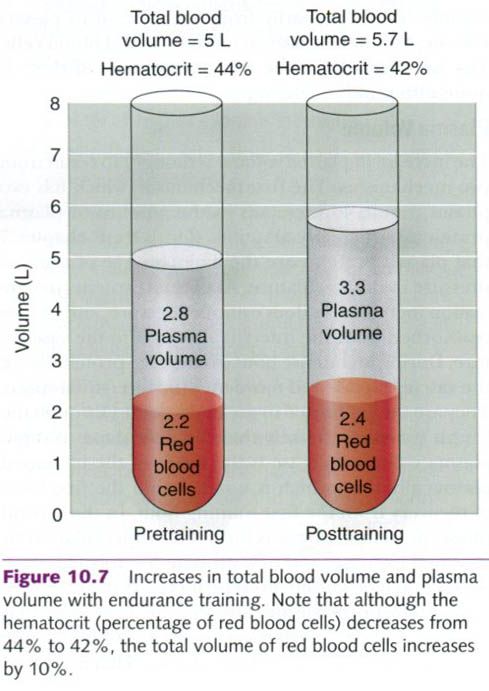
Endurance training increases blood volume, and this effect is larger as training intensity increases. Furthermore, the effect occurs rapidly. This increased blood volume results primarily from an increase in plasma volume, but there is also an increase in red blood cells. The time course for the increase of each of these is quite different.

Plasma volume

The increase in plasma volume is thought to result from two mechanisms. The first mechanism, which has two phases, results in increases in the amount of plasma proteins, particularly albumin. Plasma proteins are the major source of osmotic pressure in the vasculature. As plasma protein concentration increases, so does osmotic pressure, and fluid is reabsorbed from the interstitial fluid into the vasculature. During an intense bout of exercise, proteins leave the vascular space and move into the interstitial space. They are then returned in greater amounts through the lymph system. It is likely that the first phase of rapid plasma volume increase is the result of the increased plasma albumin, which is noted within the first hour of recovery from the first training bout. In the second phase, protein synthesis is turned on(upregulated) by repeated exercise, and new proteins are formed. With the second mechanism, exercise increases the release of antidiuretic hormone and aldosterone, hormones that cause increased reabsorption of water and sodium in the kidneys, which increases blood plasma. That increased fluid is kept in the vascular space by the oncotic pressure exerted by the proteins. Nearly all of the increase in blood volume during the first two weeks of training can be explained by the increase in plasma volume.

Red blood cells

An increase in red blood cell volume with endurance training also contributes to the overall increase in blood volume, but this increase is an inconsistent finding. Although the actual number of red blood cells may increase, the hematocrit – the ratio of the red blood cell volume to the total blood volume – may actually decrease. Figure below illustrates this apparent paradox. Notice that the hematocrit is reduced even though there has been a slight increase in red blood cells. A trained athlete’s hematocrit can decrease to a level where the athlete appears to be anemic on the basis of a relatively low concentration of red cells and hemoglobin.


The increased ratio of plasma cells resulting from a greater increase in the fluid portion reduces the blood’s viscosity, or thickness. Reduced viscosity may facilitate blood movement through the blood vessels, particularly through the smallest vessels such as the capillaries. One of the physiological benefits of decreasing blood viscosity is that it enhances oxygen delivery to the active muscle mass.
Both the total amount(absolute values) of hemoglobin and the total number of red blood cells are typically elevated in highly trained athletes, although these values relative to total blood volume are below normal. This ensures that the blood has more than ample oxygen-carrying capacity. The turnover rate of red blood cells also may be higher with intense training.

Search this blog